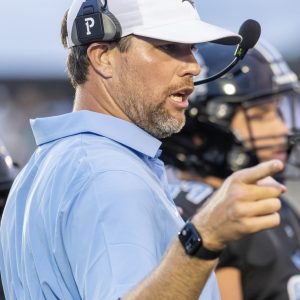
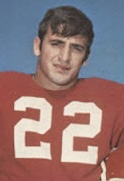
Ronny Massey, above, walked on at Alabama before transferring to Alabama and was often mistaken for Johnny Musso, below.
By JIMMY WIGFIELD
When Ronny Massey walked on at Alabama, he had no notion he would be part of making history with one of the nation’s most historic programs.
After leading Chatom High School to back-to-back 9-0 seasons in 1968 and 1969, he walked on with the Crimson Tide and was often mistaken for star running back Johnny Musso insomuch as they resembled each other in the face; however, Massey was the Chatom Phantom, not the Italian Stallion.
“People used to think they were brothers because they both had those broken noses and that dark, curly hair,” said Massey’s wife, Helen “Ace” Massey, whose future husband matched Musso’s work ethic, if not his talent level.
“They would actually be the first ones to practice and the last ones to leave,” she said. “They’d run the bleachers together.”
Massey made coach Paul “Bear” Bryant take notice of him well enough that he joined the scout team as a running back to prepare the defense for that week’s opponent.
His first assignment in 1970, according to Ace, was to simulate Southern Cal tailback Sam “Bam” Cunningham, a Black star on the first fully integrated team to come to Legion Field.
Cunningham ran over Alabama in a 41-21 victory that helped Bryant convince reluctant boosters and fans that it was also time to fully integrate the all-white Tide.
Unfortunately, Massey couldn’t duplicate Cunningham’s devastating, overpowering running style.
“Ronny said the defense didn’t know what was going to happen to them,” Ace said.
But what happened to Massey afterward was much happier because the prescient Bryant saw something in him that changed his life.
Massey’s brother Edward, who was in law school at Alabama at the time, told Ace of a chance meeting with Bryant in which the legendary coach looked accurately into the walk-on running back’s future.
“Coach Bryant told Edward, ‘He is going to be a leader of men and we don’t need to keep him on the sideline,’” Ace recalled. ‘“He could start at another school. A former player of mine is coaching at Livingston. I could call him.”’
The former player was Mickey Andrews. Massey transferred and was part of the 1971 NAIA national championship team and quarterbacked the Tigers to the 1972 finals before finishing his career in 1973. A year later, Massey started one of the most successful high school coaching careers in state history.