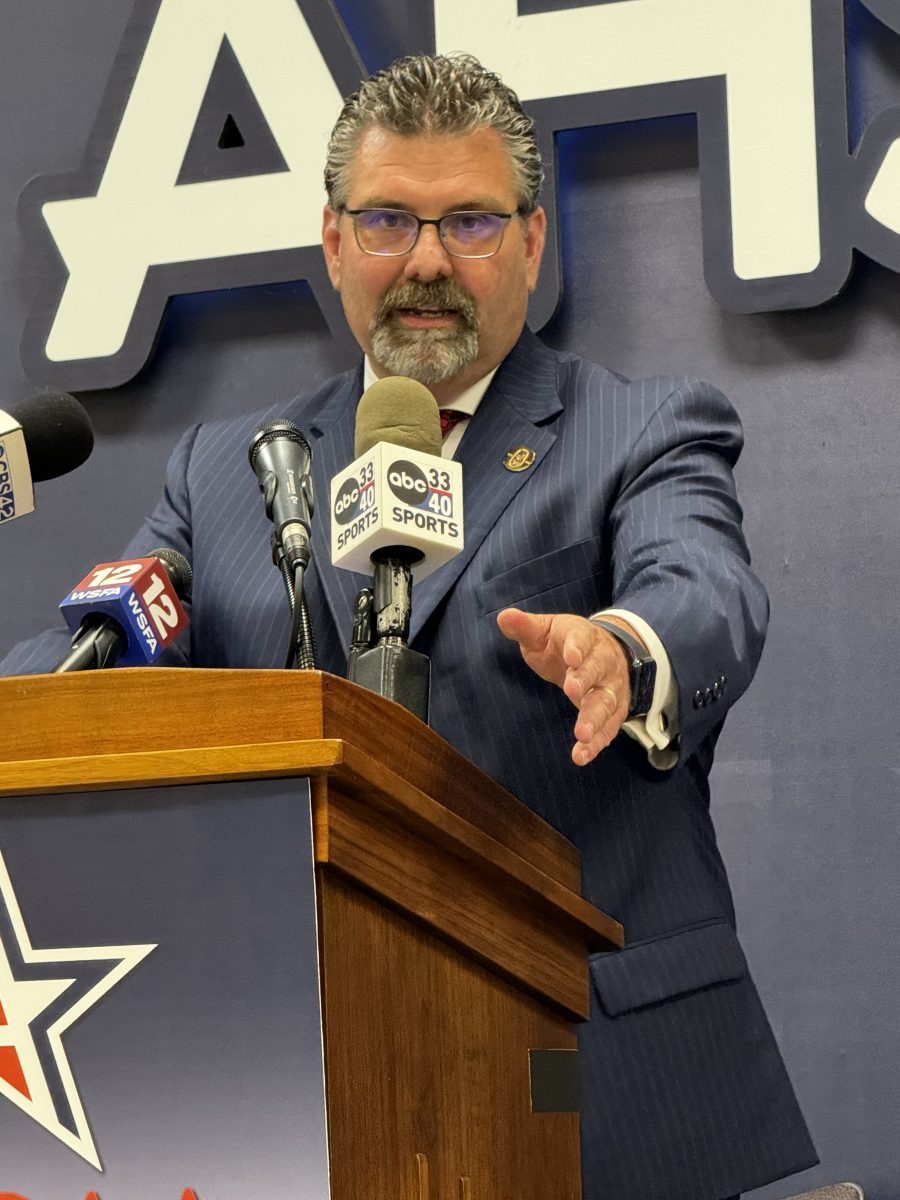
New Alabama High School Athletic Association Executive Director Heath Harmon is under increasing pressure to enforce rules barring recruiting between high schools and improper transfers and has promised he will do so. (Jimmy Wigfield/Call News)
___________________________
Fewer and fewer want to climb the hills when the easy way is open, even if it requires cheating, and this attitude has taken hold of some who claim they love what sports teaches. But I think they slept through that class.
___________________________

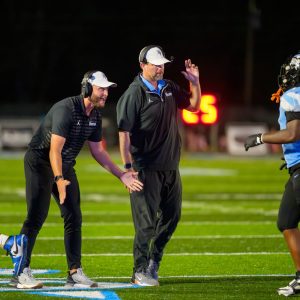
St. Paul’s coach Ham Barnett didn’t plan to say what he did but his disillusionment and disgust boiled over.
“It’s unfortunate what high school football has become,” Barnett said during the recent Mobile County Media Days. “It’s not an amateur sport anymore because you got adults my age who are making phone calls and doing things they shouldn’t be doing.”
Those things include coaches and/or “friends of the program” trying to entice a player or players from institution A to come play for institution B while wiping their keisters with the rulebook.
But why isn’t the Alabama High School Athletic Association rulebook being obeyed, especially since coaches and schools authored it to begin with?
“You have to have a backbone in Montgomery,” Barnett said. “If you don’t have a backbone, you don’t need the job. I don’t think in the last three years they have done anything about it, so it’s like the wild, wild West.”
Having a backbone in this case means growing one, which is natural for newborns but not so easy for grown men and women.
New AHSAA Executive Director Heath Harmon has promised he possesses a fully functional spine that he is willing to use. He said it when he got the job a couple of months ago and reiterated it a few days ago.
“It’s very important that everybody understands that I’m 100 percent committed to us following our rules,” Harmon said Friday on the “On the Mark” radio show with D. Mark Mitchell. “Our member schools have come up with these rules and it’s my job as executive director to make sure we are enforcing them consistently.”
Harmon said he understands the perception that “sometimes you can get a little bit more talk than action,” inserted the caveat “that takes time,” then added: “I don’t think it will take very long to see” he will clean up what must be cleaned up, including the soiled rulebook.
Back in Mobile, Barnett said he hopes Harmon is a man of his word.
“I hope he’ll do what he said he would do and enforce the rules,” Barnett said. “Only time will tell. Like he said, actions speak louder than words. Will he take his time or will he go in with guns blazing and enforce what is on the books right now?”
When the subject was broached — as it often is these days — Barnett couldn’t hold back his concern for what can rightfully be viewed as a dying way of life and his disdain for those who are helping fill out the death certificate.
“I didn’t mean to be so forceful but it hit a nerve,” he said. “The first two years I was here, I lost seven starters who transferred. A few of them didn’t think we were moving in the right direction but I know for a fact I’ve got kids this year who have been contacted by other schools.”
Many other coaches nodded in silent agreement when Barnett’s “have to have a backbone” comment reverberated off the walls and they voted with their cell phones afterward.
“I’ve had a dozen coaches call me and text me to thank me for standing up for them,” Barnett said. “All of them are frustrated. … The field needs to be an even playing field and right now I don’t think it’s even.”
This isn’t a recent development, of course. Recruiting has been going on for years but now it seems more blatant.
The rules require a principal to file a written complaint about improper transfers and recruiting and request a decision from the executive director. But many principals don’t want to roil the waters and some coaches are reticent about providing verifiable information because they dread being fingered as a snitch within the coaching brotherhood.
Barnett’s point is even when complaints are filed, they have been ash canned.
“The last few years, schools have been turned in and the state wasn’t going to do anything unless that school self-reports,” he said. “They had clearly broken the rules and nothing happened. Coaches see the state is not going to do anything, so they think, ‘We’ll continue with what we’re doing.’”
Rules, of course, must be enforced and the guilty should be punished. For coaches and “friends of the program,” I feel that could involve firing, fining and/or barring them from getting another job in athletics in the state for a set period of time. A byproduct of that is being publicly identified by name and feeling the scorn that comes from being a pariah in their communities, from costing the beloved local school some victories. They wouldn’t even be able to go to the nearby convenience store to get some beef jerky without being chewed out and chewed up themselves.
Unfortunately, there is another side of this that most people don’t think about and which cannot be corrected by regulations.
The diseased underbelly that is oozing its unseemly pus on high school football is only a symptom of a much larger vexation in society, one I fear will not change for the better. We have become a nation of selfish privilege instead of sacred sacrifice with a growing cadre of misguided whiners — adults and minors alike — who think they should be given what they want without earning it. Fewer and fewer want to climb the hills when the easy way is open, even if it requires cheating, and this attitude has taken hold of some who claim they love what sports teaches. But I think they slept through that class. Their example will leave nothing of lasting value behind.
Another truth that should make honorable people tremble is that loyalty cannot be legislated and that it is in scarce supply. What good is a player to a team if he is forced by rule to stay where he doesn’t want to be?
I say most schools still heed the rules. Parents on their own can visit a school to inquire about a transfer and bona fide moves are fine.
But recruiting is more prevalent in the larger programs than the smaller ones. In smaller communities, dreadful consequences would be visited upon a family and make it too hot to live in if parents had the audacity to peddle their sons to play for other schools or allow outsiders to recruit them.
“That’s a safe assumption,” said Leroy coach Chan Lowe, whose Bears have won the last two Class 1A state championships without defiling the rulebook. “There would be some animosity there.”
Lowe views it as a “big-city problem” and explained why.
“In some of the smaller places, that school is about all we’ve got,” he said. “Tradition and community pride have been there so long. We’ve got players now who won the state championship whose kinfolk played on a state championship team. It would be tough if word got out about any parent doing that.”
And it’s not as if Leroy doesn’t have players worth recruiting. Four have signed with colleges the last two years.
Purity in the sport, Lowe said, is rapidly receding.
“I’d say within 10 years, the only way you’ll find it is in the small towns,” he said. “I’ve had conversations with my wife and I’ve said I don’t know that I’d want to be anywhere above a 3A. I love it that it’s still about football in our community. The larger schools, it’s become more of a small college.”
But being publicly humiliated and forced to forfeit games for transgressions would not go unnoticed in any community, city and school, big or small.
“Some of these schools breaking the rules are winning a lot of games,” Barnett said. “Think about the type of impact that would have if a team wins 10 games in the regular season and then they have to forfeit all of those games. Guys will definitely think twice about doing that type of stuff.
“I don’t want a bunch of adults ruining high school sports. Let the kids be kids and enjoy it and have to go through some adversity.”