Larry Henderson: A stern coach who listened to his players and helped Mobile high school football break through to the top

Murphy coach Larry Henderson looks at his offensive linemen get set for a play during a practice in 1984. Henderson, who led the Panthers to the 1983 state title, the first Mobile team to do it since the playoff system started, will be honored with a lifetime achievement award this month. (Jimmy Wigfield/Call News)
 Paul Davenport had no idea why he was being summoned to his head coach’s office in the offseason before his senior year but he did know three things: One, that coach was a large man whose head seemed to brush the sky and had a voice somewhere between thunder and a diesel engine on a dump truck. Two, that coach was the only person on a football field who could unnerve the otherwise unnervable and terrifying lineman Bill Condon. And, three, it must be bad news.
“You were just scared to death,” Davenport said of the meeting each senior had with Murphy coach Larry Henderson, who in his first year in charge had just led one of the state’s preeminent programs to its first losing season in 16 years. In the venerable environs of 100 South Carlen Street, home to the oldest high school in the state, Davenport felt sure some changes were damn well coming.
Condon, a two-way lineman who went on to star at Alabama, thought the same.
“He was kind of an intimidating person,” Condon said of Henderson. “We all had a lot of respect for him but we were also a little scared of him.”
Condon, it must be said, feared no one on the field. Anyone who challenged him often found new, anatomically incorrect ways of wearing their helmet and it was with this in mind that Davenport approached Henderson’s door.
“I mean, Henderson was one tough dude,” Davenport said. “He was the only coach I ever saw that whipped ol’ Condon around. Condon used to mess with those coaches at Alabama but he never did with Henderson.”
Davenport wondered what Henderson was going to say to him. Would it be like the practice in which Henderson overheard Condon say something disparaging in the huddle? Davenport recalled the terse exchange as classic Henderson:
“What the (blank) did you say, Billy?” Henderson asked.
“Nothing, coach.”
“That’s what I thought you said.”
If Condon stood no chance in Henderson’s presence, Davenport was bumfuzzled about what would happen to a mere running back. Surely, each senior was being told how they would conform and informed of the medieval training methods they would endure, as they had during the 3-7 season just concluded.
“Henderson was more of that old-school, bust-you-in-the-mouth kind of guy,” Davenport said. “He would run us to death with sprints all week long and full tilt all week long and we were worn out. We left it all on the practice field.”
He recalled a game in the middle of the 1982 season, when the Panthers lost their seven games by 1, 2, 3, 4, 3, 6 and 9 points.
“Me and another player were sitting in Ladd Stadium in the locker room and we were about to play and he goes, ‘Man, I don’t even want to play,’” Davenport said.
But come the appointed time for Davenport’s face-to-face meeting with Henderson in the offseason, he observed his coach holding a folder, a piece of paper and a pen — odd instruments for a metaphorical thrashing.

Former Murphy fullback Paul Davenport: “It starts at the top, that selfless attitude. For him to ask us in his office and ask a player what you thought was wrong, that’s just the way it was.”
“He wanted to know what I thought was wrong with the team last year,” Davenport said. “You could tell the way he was asking, he was asking sincerely. It wasn’t like, ‘You better not say something I don’t want to hear.’ That was amazing to me that a coach would do that. I said, ‘Well coach, the only thing, I just thought we left a little on the practice field last year.’ He wrote it down.”
Condon had shared similar sentiments: “We pretty much let him know that we felt like we didn’t need to be in full pads Monday, Tuesday and Wednesday,” Condon said.
But when preseason practice began, the hopes of Davenport and Condon seemed to be sucked into the wet blanket that hovered over Murphy’s humid practice field.
“He busted our ass in August, like he should, and ran us to death until we were about to drop,” Davenport said. “But once the season started, there were no more of the sprints, no more of the full contact all the way to Thursday and all that other stuff. And we rolled.”
The 1983 Panthers made history, going 14-0 and becoming the first Mobile team to win a state championship since the modern playoff system began in 1966. Davenport surfed 27 yards in a monsoon for the only touchdown in the 7-0 win over Austin to claim the Class 4A Blue Map at Legion Field.
Henderson, now 85, who also took his 1989 and 1990 Murphy teams to runner-up finishes, will be deservedly honored with a lifetime achievement award by the Alabama Football Coaches Association on Jan. 25 in Montgomery.
Teams from the southern end of the state had long been ridiculed as physically inferior to teams from the north and that included Murphy, which had strong armed other Mobile teams for years before being routinely beaten in the playoffs. But the Panthers’ 1983 breakthrough changed that; since then, 25 Mobile-area schools have won state championships.
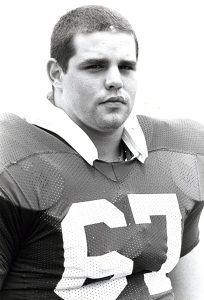
Former Murphy and Alabama lineman Bill Condon: “His legacy was winning that first championship. It paved the way for the high schools in Mobile to follow suit.”