Mobile gets Super 7 championships in 2026, 2028
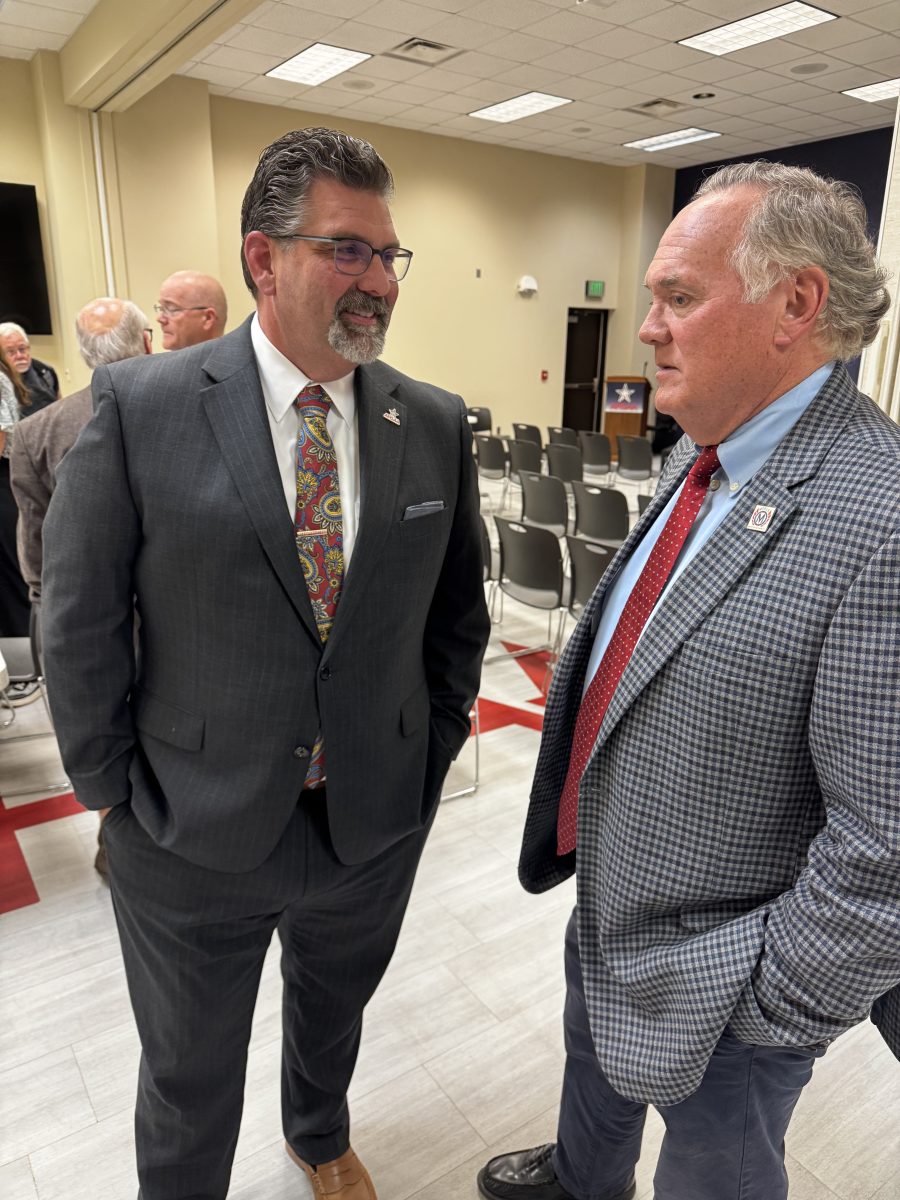
Alabama High School Athletic Association Executive Director Heath Harmon, left, and Mobile Sports Authority Executive Director Danny Corte visit on Wednesday in Montgomery after Harmon announced Hancock-Whitney Stadium will be included in a Super 7 rotation in 2026 and 2028. (Jimmy Wigfield/Call News)

Hancock-Whitney Stadium on the University of South Alabama will host the Super 7 in 2026 and 2028, the AHSAA announced on Wednesday. (Photo courtesy of the Mobile Sports Authority)
By JIMMY WIGFIELD
MONTGOMERY — After decades of traveling hundreds of miles to play for a state football championship, teams in the southern part of Alabama will have a much shorter drive in the foreseeable future.
Mobile’s Hancock-Whitney Stadium joined in a two-city rotation with Birmingham to host the Super 7 in 2026 and 2028 after the Alabama High School Athletic Association’s Central Board approved the plan Wednesday.
AHSAA Executive Director Heath Harmon made the recommendation after a nearly 40-minute executive session and the Central Board unanimously approved it. Birmingham’s Protective Stadium will host the Super 7 in 2025 and 2027 and Harmon said the AHSAA is leaving open the possibility of adding another city to the rotation and expanding the event to four days in the future.
“Fired up is an understatement,” Mobile Sports Authority Executive Director Danny Corte said after a few heart palpitations awaiting the news. “Mobile has never hosted a major Alabama High School Athletic Association championship. It’s a big step.”
After 2½ hours of mostly routine business, Central Board President and legendary UMS-Wright coach Terry Curtis declared the private executive session to discuss the Super 7 sites and after 40 minutes reopened the board room for the announcement.
“When Terry said, ‘Hey, come on back in,’ that’s when I got nervous,” said Corte, who quietly pumped his fists when the board voted to welcome Mobile to the rotation.
However, Curtis put Mobile and Birmingham on notice that the AHSAA will be closely evaluating both cities over the next four years and will be willing to make changes if necessary.
“I like the four years,” he said. “It gives both of them two years. And believe me, this board, if you can’t do it, or nobody can do it, nobody shows up for the games, you’re not going to keep it because we’ve got a lot of people wanting it. I just think that’s a no-lose situation for us.”
Curtis, whose UMS-Wright teams have won eight Blue Maps, said having a memorable experience at the Super 7 — as Bryant-Denny Stadium, Jordan-Hare Stadium and Legion Field provided — is more important than the site.
“My thing to the board was, I’ve been there, done that, been to Alabama, Auburn, Legion Field,” he said. “I just want to make sure that those kids have the same experience and memories that my kids had when they went to those venues. And I’ve told Mobile that. I’ve told Birmingham that. Mobile’s got their hands full. They’re going to have to step up and do it because this thing is about the kids. Location may be a little important but, really, I don’t think a football team who makes the state championship is going to matter one bit whether they go to Mobile or Huntsville or Dothan or wherever.”
Harmon said Corte relentlessly promoted the assets of Mobile and the University of South Alabama’s 25,000-seat stadium as Super 7 hosts.
“If Mobile does as good a job with the game — and I know they will — as they did trying to get it, we’re in for an elite experience,” Harmon said. “(Corte) was very persistent. I’m just excited for our kids and for our association that we did have that kind of commitment from the sites (that made bids). … Mobile certainly wants to have the event and they’re committed to making it special for our schools, our athletes and our communities.”
Biggest sporting event
in the history of Mobile
Harmon said he saw the benefit of a four-year rotation and pointed out many AHSAA championship events are not centrally located.
“I just thought it made sense for the four years,” he said. “With that, I was trying to look for the two best options right now. When you move an event around the state, you’re able to give people a chance who are interested in doing this and you’re able to showcase your sport. We have soccer in Huntsville. We have track in Gulf Shores with over 2,000 athletes. We have bowling in Mobile. Baseball and softball is at Oxford and Jacksonville State. It’s not centrally located.”
Last year, Corte told the Call News the Super 7 would be the most significant sporting event in Mobile history with 40,000 fans coming to the city for the December event. Corte said the economic impact in Mobile would be $15 million to $20 million.
Corte said the 1994 American Bowling Congress’ 91st Championships is currently the biggest event in Mobile’s history — with 46,425 people attending over five months — but that will pale in comparison to the Super 7.
“If we get the Super 7 and 46,000 people coming through the gates in three days, that becomes bigger than anything in Mobile — bigger than the Senior Bowl and the 68 Ventures Bowl,” he said.
The Super 7 drew 41,264 fans in three days in Birmingham last year, 43,014 in Tuscaloosa in 2023 and 61,519 in Auburn in 2022.
Corte declined to specify how much Mobile bid to get the Super 7 but said it was above the minimum of $250,000 set by the AHSAA. The City of Birmingham, its convention and visitors bureau and the Birmingham Jefferson Civic Center Authority signed a deal in October 2020 to pay the AHSAA $200,000 for each Super 7 it hosts.
Harmon said the experience Mobile has with hosting the Senior Bowl, the Alabama-Mississippi All-Star Game and the North-South All-Star Game were factors in the decision.
“They know how to host these big-time events,” he said. “And they’re committed to having an elite experience for everyone. So is Birmingham.”
Four years, maybe four days