With historic decision looming, most AHSAA coaches don’t seem to want a split from private schools and worry about a messy divorce

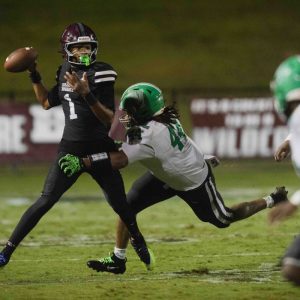
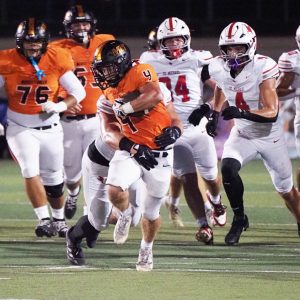
Games such as Saraland against St. Paul’s in the regular season or the playoffs might be a thing of the past when the Alabama High School Athletic Association decides whether to keep public and private schools together or split them apart. Here, Spartans quarterback Jamison Roberts throws a pass against the Saints last season. (Call News file photo)
__________________
Most coaches don’t seem to want a split but major change seems inevitable in an increasingly rancorous environment marked by transfers and recruiting
__________________
By JIMMY WIGFIELD
It seems unlikely that the status quo will survive when the Alabama High School Athletic Association officially announces its reclassification on Jan. 23 and possibly renders an historic decision on how public and private schools will or will not coexist.

AHSAA Executive Director Heath Harmon could make a major announcement on Jan. 23 or delay it to provide more time to come to a resolution. (Call News file photo)
The AHSAA’s Central Board is facing pressure from its member schools and the state government that could result in a massive alteration of competition. Public and private schools will either remain knitted together but have separate playoffs or the seams might be completely ripped out, resulting in a split that many feel will be catastrophic.
“I would hate to see that happen because it’s worked well over the years,” Alabama Football Coaches Association Executive Director Jack Wood said. “I do know for a fact that the states where the split is, football coaches do not think it’s been a good thing for either side in the long run. The majority, by far, of the private school coaches that have called me, they hope that compromise is reached.

Alabama Football Coaches Association Executive Director Jack Wood wants a compromise. “Nobody has got on a black hat,” he said. (ALFCA photo)
“We had a board meeting at the Super 7 and in talking to a lot of the guys unofficially, I don’t know anybody that says, ‘Oh, we want this to happen.’”
The issue came to a head when Gov. Kay Ivey and Alabama House Speaker Nathaniel Ledbetter sued to force the AHSAA to allow students who transfer using CHOOSE Act funds to be immediately eligible. The effect would mostly benefit private schools, which have long felt unfairly penalized by the AHSAA because of their perceived advantage in recruiting players.
The CHOOSE Act, which provides school choice, was not originally intended to override the AHSAA’s existing policy but the controversy roiled when the AHSAA elected to brand the use of government funds to switch schools as an extra benefit, thus forcing those transfers to sit a year.
“The three entities — the Legislature, the public, the private schools — nobody has got on a black hat,” Wood said. “Everybody’s got valid points. Whether people agree or disagree about the CHOOSE Act, that’s going to stay here and it’s very valid. They need to make sure the CHOOSE Act is dealt with appropriately, that all schools are treated equally in that and then compromise to maybe try to level the playing field as much as possible.”
Proposals being floated include creating six classes of public schools and two classes of private schools and allowing them to play each other in the regular season but staging separate playoffs; unshackling the private schools from the 1.35 multiplier and applying the competitive balance rule equally; or the private schools forming their own association, which some coaches have described as the athletic version of the nuclear option.
“Having the private schools and the public schools together creates the best brand of ball,” said Mary G. Montgomery coach Zach Golson, who has also coached at private schools. “I’m hopeful that we can keep all of our schools together in one league. I see a world where breaking championship play apart creates an even bigger divide amongst the private and public-school teams.”
Ronnie Cottrell, who now coaches at public-school T.R. Miller but also won a state championship at Mobile Christian, said the rules are biased against private schools.
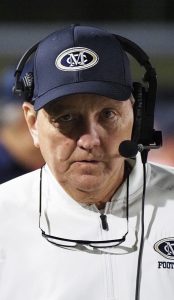
T.R. Miller and former Mobile Christian coach Ronnie Cottrell warned of chaos similar to that in Florida: “In Florida right now, you can go to any school you want to go to and play. You can play football in one high school at the start of the fall, you can go to a basketball school in January, then play baseball or run track in the spring at three different schools if you want to. All in the same year. (Florida) also has NIL and it is a very dangerous thing.” (Call News file photo)
“I agree with the original intent of the multiplier but I didn’t like the competitive balance concept,” said Cottrell, whose Tigers lost to four private schools in 2025.
“I think the private schools want to do away with those rules that penalize them. There is no feeling like that feeling as a coach to walk off the field at a championship game and know that you could be there again the next year but you know when you walk off that field that you’re going to be moved up.”
Central Board President Terry Curtis has urged postponing any decisions until the next reclassification in 2028 and using the time to reach a reasonable and fair consensus.
“Believe me, every time I wake up at night, it pops in my mind,” Curtis said. “It’s hard to think about anything else. If something drastic or whatever is done, it’s going to change everything we’ve done. It’s going to really change the association even. Not only just the schools but the association.”
Wood also wants the AHSAA to exercise restraint.
“I don’t see how it would be humanly possible for compromise where there’s equal opportunity with the public and private schools and dealing with the Legislature, how that could be done in less than a month,” he said.
Tough love needed
None of the coaches who spoke to the Call News favor government involvement in AHSAA policies.
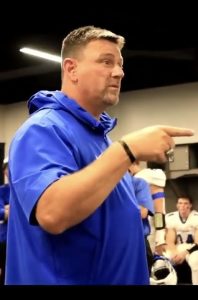
Auburn coach Keith Etheredge doesn’t want politics to shape a decision. “I know a lot of people in politics and they mean well but then you start throwing politics into a private entity that has ran itself for so long, I hate to say it but it becomes corrupt,” he said. (Auburn High photo)
“I know a lot of people in politics and they mean well but then you start throwing politics into a private entity that has ran itself for so long, I hate to say it but it becomes corrupt,” Auburn coach Keith Etheredge said. “If we’ve got a state legislator and he lives in Opelika or Phenix City and he’s deciding on what’s happening in Auburn, I’m going to feel like we’re not getting a fair share. The politicians are going to make decisions where they’re going to get votes. If I’m in politics, I may do the same thing. You want to get voted back in, you’ve got to listen to your constituents.”
Saraland coach Jeff Kelly said the AHSAA is capable of adjusting to the times.
“Success comes and goes with time and changes to the landscape,” Kelly said. “I think all parties need to come together and try to work it out. However, it shakes out, let’s handle it within our association and not the Legislature.”
Cottrell said government intervention in Florida, where he coached Godby-Tallahassee to a state championship in 2012, has led to chaos.
“In Florida right now, you can go to any school you want to go to and play,” he said. “You can play football in one high school at the start of the fall, you can go to a basketball school in January, then play baseball or run track in the spring at three different schools if you want to. All in the same year. (Florida) also has NIL and it is a very dangerous thing.”
Many coaches acknowledge that public schools are now recruiting just as much or more than private schools.
“Some private schools do it right and the majority of the public schools do it right,” Central Clay County coach Danny Horn said. “It’s just that 10, 15, 20 percent that don’t do it right that’s creating a lot of problems.”

Central Clay County’s Danny Horn, the state’s all-time winningest coach, said tough love is needed to save high school athletics. “The Alabama High School Athletic Association has got to crack down,” he said. “How do you do it? You rule transfers ineligible for a year like they used to and there’s no exceptions.” (Call News file photo)
Etheredge said some who train athletes off campus push players to transfer to schools they like or are associated with.
“There’s some public schools right now getting after it,” Etheredge said. “They’re using all these training facilities and stuff like that to push kids to places. I know guys who train kids and do it the right way. But when you have places that train kids and there’s four or five of those kids that all of a sudden they are transferring to this school or that school, it just throws up the red flag.”
Horn, the state’s all-time winningest coach, said tough love is needed to save not only football but all high school sports.
“The Alabama High School Athletic Association has got to crack down,” he said. “How do you do it? You rule transfers ineligible for a year like they used to and there’s no exceptions. What people don’t understand about a bona fide move is you have got to leave that house. You can’t even have furniture in it. And you’ve got to move into a school district of the school you’re transferring to and people are not doing that. You can’t tell me everybody’s doing it because it’s very costly to move around to begin with.”
Schools in a headlock
Some coaches feel public schools, especially city schools, have an advantage in attracting players. Others believe private schools do.
However, Etheredge said students cannot attend Auburn High unless they live in its district.
“They will not even let you register unless you have an Auburn High School address,” he said. “You’re not going to be able to move in here if you’re not in the city limits of Auburn unless you make a bona fide move.”
Etheredge acknowledged the benefit of city schools keeping local tax revenue instead of sharing it the way a county system must.
“That’s a big deal and I think that’s why we’re very high on the chart when it comes to graduation rate, when it comes to education, when it comes to athletics across the board,” he said.
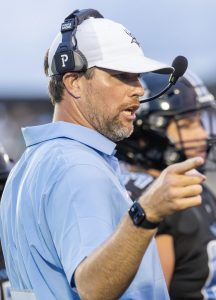
Mary G. Montgomery coach Zach Golson said private schools have some advantages but not all transfers have improper motives. (Call News file photo)