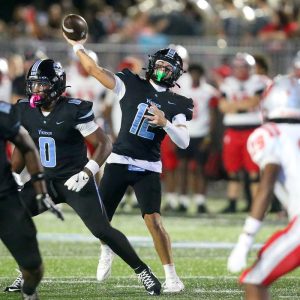
UMS-Wright’s Perry Hand celebrates a touchdown during a win over T.R. Miller in 2025. Regular-season games between public and private schools seem less likely now, although the AHSAA officially split them only in postseason play. (Call News file photo)

Mobile Christian’s Jason Todd breaks free against Jackson last year but games between private and public schools may be less frequent after the AHSAA’s decision last week to separate them for postseason play. “You can call it whatever you want but at the end of the day, it’s a separation,” Mobile Christian Head of School Clint Mitchell said. (Call News file photo)
By JIMMY WIGFIELD
The state’s private schools did not declare an open rebellion and sever ties with the Alabama High School Athletic Association at a meeting in Montgomery Friday but headmasters and coaches hope they can build enough leverage to alter some of last week’s historic changes.
The AHSAA’s Central Board voted on Jan. 23 to split the public and private schools for postseason play, eliminate the 1.35 multiplier and competitive balance rules for private schools and allow any transfer to a private school to be immediately eligible if they use CHOOSE Act funds.
The plan has been widely criticized by private school leaders who feel their schools have been marginalized and feel the concessions are meaningless since they will have no effect on making private schools more competitive with public schools. But no threat materialized to completely break away from the AHSAA and form their own association.
“I didn’t hear anything today that would indicate to me that’s a consideration right now,” UMS-Wright Head of School Doug Barber said. “I think there is still a commitment that it’s better for our private and public schools to be in competition with each other. I didn’t hear anybody say, ‘You know, this is the last straw, we’re going to break away.’ I think we need to honor what we’re in as long as we can make it as equitable as we can. … Our coaches don’t want to see this landscape completely turned upside down because we’ve got examples all over the place where that doesn’t work well.”
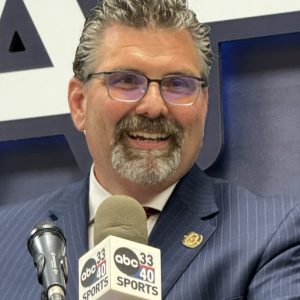
Barber was among private school headmasters, coaches and athletic directors at Friday’s meeting at Faulkner University. Lt. Gov. Will Ainsworth, an outspoken critic of the AHSAA, and AISA Executive Director Michael McClendon were also there but AHSAA Executive Director Heath Harmon was not.
“I was really proud of the opportunity to be among all those private school heads,” Barber said. “I’ve never had a meeting that way before and that was really good. I would say there were no surprises. Everybody was unified and committed to the way things are right now and getting behind the decision and seeing if we can make it work. We’re trying to find a solution that continues to give all our kids the best opportunity from an athletic standpoint and keep reaching and searching for ways to have really quality, fair representation at whatever level we are.”
Barber and Mobile Christian Head of School Clint Mitchell, who was also at the meeting, said private schools now have a stronger voice and are willing to judge the new format two years from now, when the next reclassification is scheduled.
“If you come out and you get emotional about it and you just react to this thing, you make a knee-jerk reaction — ‘If they don’t want us, just go’ — that’s not necessarily a message that we want to send to our kids, that whenever you get something that’s not going your way, you just up and leave,” Mitchell said. “We’re going to try to be smart about it. We’re going to take our time.”
Barber said he expects more meetings among the private schools.
“It forced us to the table a little bit more,” he said. “Anytime you can collaborate with schools or organizations or businesses or people that you know can be like-minded, I think it does create a little momentum for you.”
Mitchell said the upheaval could have been avoided if the private schools felt the AHSAA had listened to their concerns but also said the private schools didn’t feel a sense of urgency to address it.
“If private schools had their say, there wouldn’t have been a change in the first place,” he said. “We would have been able to stay as it is and make minor adjustments. If there’s one thing that’s probably been the most disappointing to me throughout the whole process, it’s that what happened today never really happened before the break. There was never a meeting where we had leaders from various institutions get together and talk. Today was the first day that I was able to be in a room with some of our private schools that are at the northern part of the state or the east and so on.”
While the public and private schools can play in the regular season, private school football coaches are concerned that fewer public schools will feel it is in their best interests to play because the multiplier and the competitive balance rule have been removed. Private schools also feel at a disadvantage with far-flung travel, filling out their schedules and smaller schools being uncompetitive.
“Every independent school is different,” Barber said, “but it’s also probably been the thing that’s prevented us from being more unified as a group. My challenges at UMS are different than a lot of other schools’ challenges as far as travel and considerations and size. I think I am more empathetic to all the different schools and seeing them all more as peers now. I think that was the best outcome of that meeting.”
Mitchell said he is not optimistic the public and private schools will rejoin for the playoffs in the future.
“My guess would be probably not,” he said. “There’s a considerable constituency that is very thankful for this move. The more classifications, the more divisions you create, you are watering the product down a little bit. You can call it whatever you want but at the end of the day, it’s a separation.”