Watch out for that golf cart, the temper and other tales of Terry Beasley
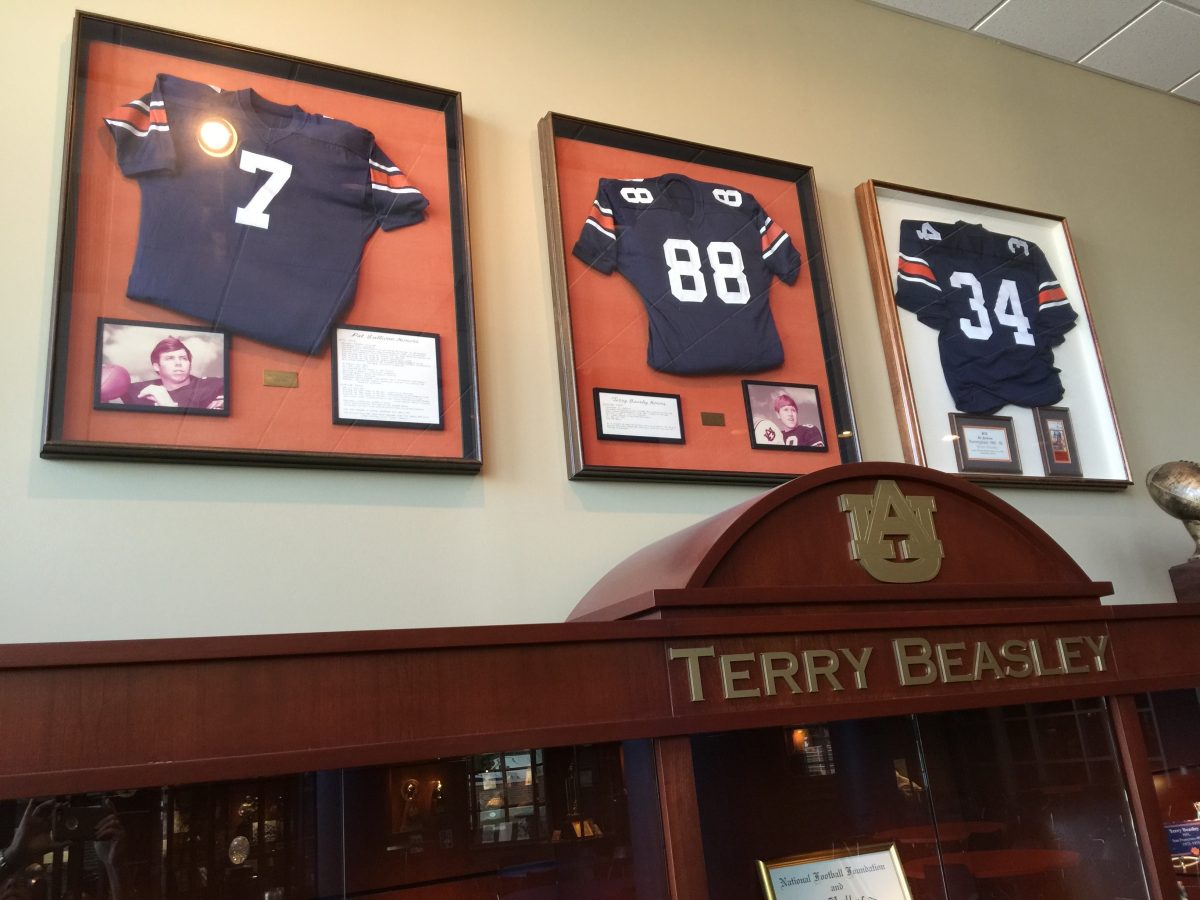
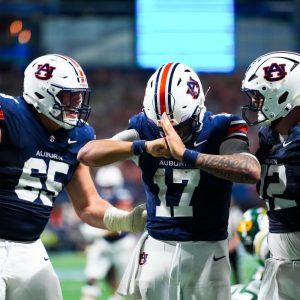
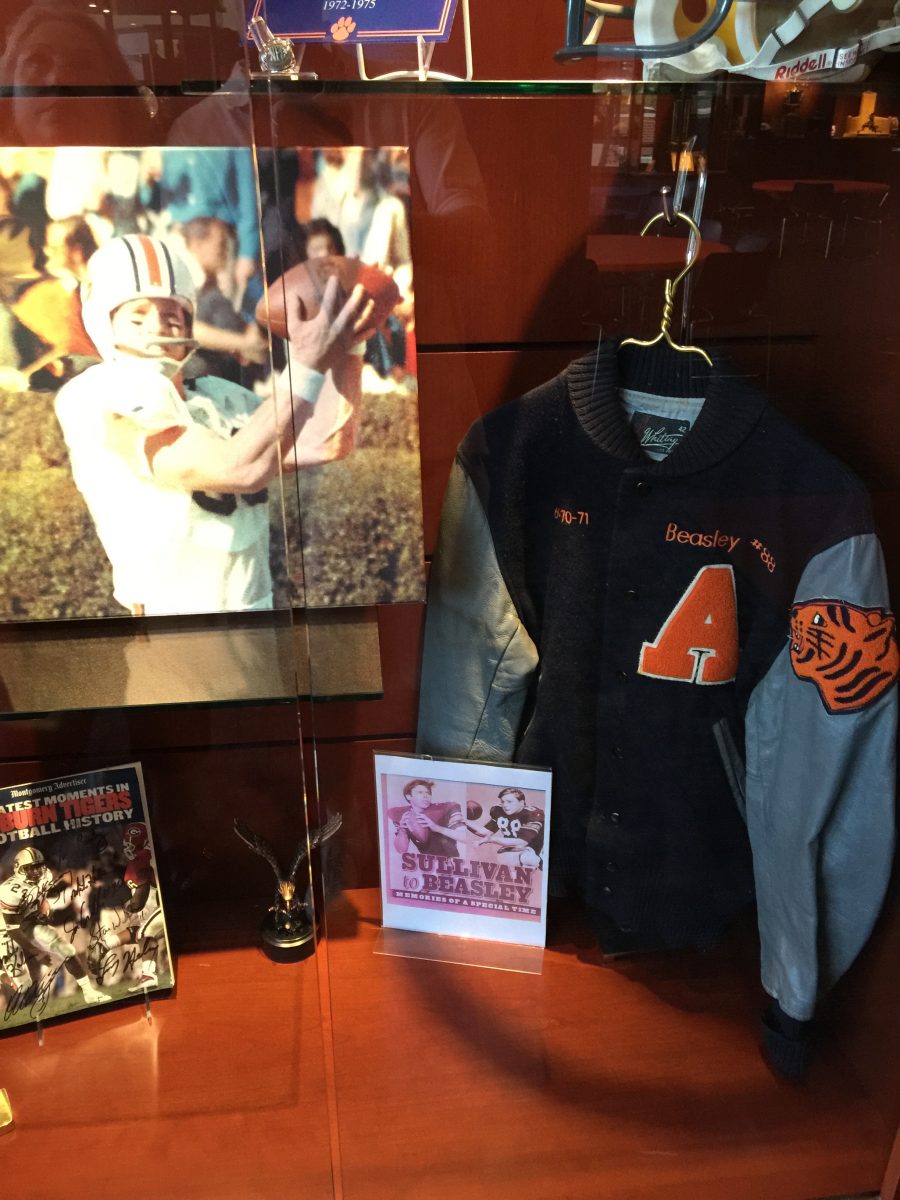
Auburn has retired three numbers in its football history: Pat Sullivan (7), Terry Beasley (88) and Bo Jackson (34). Below, Beasley’s letterman jacket is displayed at the Auburn football complex. (Call News file photos)
By JIMMY WIGFIELD
Legendary Auburn split end Terry Beasley was truly a timeless player with matchless physical gifts to go with plenty of heavy mettle.
“If he could have been transported from the 1970s to 2024, he’d be just as successful today,” teammate and fellow receiver Dick Schmalz said.
“Terry was unbelievable. He could be full speed in two or three steps and turn on a dime. It was a horrible combination for DBs. It was hammered into us about cutting and coming back to the ball. Terry was so good at that, plus the DBs had a fear of his speed and he had the ability to be so precise with his routes, it wasn’t a fair fight. And he had the strength without having to go to the weight room.”
Beasley still holds the Auburn records for career receiving yards (2,507) and career touchdown receptions (29) despite he and Heisman Trophy-winning quarterback Pat Sullivan playing in an era of conservative offenses.
Running back Terry Henley said Sullivan isn’t the only player who deserved the Heisman in 1971.
“I feel like they should have given out two Heismans that year — one to Pat Sullivan and one to Terry Beasley,” Henley said.
Beasley, who suffered 16 concussions in his college and pro career, died of an apparent suicide on Jan. 31, according to Moody police.
Henley said Beasley would have been better off not playing in the NFL.
“In the pros, he got beat up so bad,” Henley said. “Those people are paid to cut your lights out. They hurt Terry and tried to hurt him.”
Beasley gave somewhat of a benediction for his life long before his death.
“Don’t feel sorry for me,” he said in his 1999 book “God’s Receiver,” written with Rich Donnell. “I may lose the battle of the brains but I’ll win in the end because I’m on the side of God and Jesus Christ. If I die tomorrow, I believe I know where I’ll wind up.”
This is part of how Beasley got there, as recalled by his teammates and even those who played against him, in interviews with the Call News.
Hole in one
Auburn linebacker Bill Newton, who famously blocked two Alabama punts in the fourth quarter to beat the Tide 17-16 in 1972, remembered a day in practice when defensive back David Langner paid for hitting Beasley when he wasn’t supposed to.
Coach Shug Jordan had Beasley wear a yellow jersey in practice his senior year, “which meant you couldn’t hit him,” Newton said. “We were out there at practice. Shug and (trainer) Kenny Howard rode around in a golf cart. Well, David Langner didn’t care if you had a yellow jersey on or not, he was going to hit you. Terry went across on some hook and curl and David just smashed him. Shug got all excited and drove over there and ran over Langner with the golf cart trying to get to Terry. They didn’t even stop to check on Langner.”
‘Robe and slippers’
The coaches grew more protective of Beasley in practice since he was often mauled in games. He played his senior year with a dislocated shoulder suffered in the Gator Bowl when he was a junior and delayed the surgery.
“Sometimes he’d grab the back of his leg and say, ‘It’s sore,’” Henley said, “and, ooooh, six or seven trainers would be out there and coach Jordan and we’d say, ‘He’s going to be in his robe and slippers for a few days.’ (Offensive coordinator Gene) Lorendo used to say, ‘I don’t care if he practices as long as he plays.’”
Defensive back Roger Mitchell, who began his career as a walk-on, said he was worried he wouldn’t get a coveted number after striking Beasley in a scrimmage at the stadium.
“They ran a quick look-in and Mike Neel got to him and me and another linebacker hit him as he was being held up,” Mitchell said. “That was the day I was going to be awarded a number. I had walked on. Bill Newton had just been awarded a number. I already had one in mind. I was nervous after that collision but coach Jordan came down from the press box — it took him a long time to come down — and he looked at me and said, ‘It’s football, don’t worry about it. You’ll have a number in your locker tomorrow.’”
Temper, temper
There was another day when Beasley might have been glad Jordan didn’t run over him.
“Terry had a feisty temper,” Newton said. “He got ticked off one time, threw his helmet down and started walking off the field. He went across the drive to the coliseum and Shug took off after him in that golf cart. Next thing you know, here comes Shug back with Terry riding in the front seat of the golf cart just smiling.”
Langner — who went on to secure a place in Auburn lore by returning both of Newton’s blocked punts for touchdowns against Alabama in 1972 — was determined to get the best of Beasley but discovered it was a bad idea.
“Me and Langner were fighting for a position and neither one of us wanted to give an inch,” Mitchell said. “The first time we went man-to-man with Beasley, Langner jacked him up. Beasley jumped up and threw him down and stomped on him.”
Beasley showed he was the alpha dog when challenged.
“If you gave him a pretty good jolt — just to get his attention — and he wasn’t expecting it, you could count on him retaliating the next play,” Mitchell said. “You learned to do it only once. The next time, instead of running and cutting, he’d just run over you and the fight would be on.”
Added fellow defensive back Johnny Simmons: “Terry was as strong as a bull. He looked like one big muscle. He could run as fast sideways as he could straight ahead. He made everybody in the secondary better than they actually were. And he was tough. I don’t think anybody tried to start a scuffle with him.”
Auburn’s Adonis
Beasley awed his teammates with his physical appearance even before they saw what he could do on the field.
“The first time I met Terry Beasley was at the state track meet at Auburn,” Henley said. “I was a ninth grader and Terry was a 10th grader. I was in awe at the shape he was in. He had these big calf muscles and these veins running down his legs. He was put together so well and had that red hair and all and I looked like a popcorn salesman from up in the stands. He could have been a bodybuilder and God gave him that. His physical appearance was unbelievable.”
Simmons said players couldn’t help but gawk at Beasley’s legs.
“When he was in shorts, you could see the back of his legs and those muscles,” Simmons said. “Sometimes, he’d have to rub Vaseline on the top of his legs because the muscles would rub up against each other. He was strong as a bull. He’d catch the ball and knocking him down wasn’t easy. He was a complete receiver.”
Added defensive end Danny Sanspree: “I told him one time, ‘You’re like one of those Budweiser Clydesdales prancing around out there.’”
A good friend to have
Sanspree said Beasley took care of him and a lot of other freshmen.
“I can’t tell you how many times he kept my butt from being boarded,” Sanspree said. “He’d hide us out in his room. The upperclassmen would come around and ask Terry, ‘Where are your freshmen?’ and he’d say, ‘I don’t know but I sent them out to The Goalpost (a hamburger place) to get some food.’
“There were times he’d buy me something to eat and I’d tell him he didn’t have to do that and he’d call me his favorite freshman. I guess I was because I had to go pick up food for him and do his laundry. We were like errand boys but we felt obligated because he looked after us.”
Don’t do it
Simmons learned going mano-a-mano on Beasley was futile.
“Going into my sophomore year, I was first string,” he said. “They ran a curl to him and he had his back to me. I thought I was fixing to show off. Then it was all air. He was gone. Eighty yards. Touchdown.”
Even when defensive backs managed to stop Beasley, it wasn’t popular, as Mitchell found out when he broke up a Sullivan-to-Beasley bomb in an A-Day game.
“You knew what was coming on the first play,” Mitchell said. “Beasley came sprinting out to my side — he was just a stud — and I said, ‘Oh, ****. I was backing up 10 to 12 yards with a running start and Sullivan throws it 55 yards and I broke it up. The crowd booed. We ended up getting whipped pretty good.”
In good hands
Henley always marveled at how good a receiver Beasley was despite the size of his hands.
“His hands were small,” Henley said. “Most receivers have big hands and long arms. But he was so strong, when the ball came and hit his hands, I thought he was going to squeeze the air out of the ball. We never worried about him catching the ball. I don’t remember him dropping a ball when it hit his hands. Nobody could catch it over the shoulder like he did. He practiced it every day. He could catch a ball one handed that way.”
Beasley wanted the ball no matter the situation or the defense.
“He would come to the huddle and tell Pat, ‘They’re not covering me,’” Henley said. “We’d come out of the huddle and he’d be standing out there with his hands on his hips and looking at us and just be smiling. There would be a linebacker on him, a cornerback on him and a safety on him. At the snap of the ball, two steps later he was wide-open. A third of the team was over there and they couldn’t cover him.”
Henley recalled a memorable play during a 63-14 win at Florida in 1970 when Beasley rendered the Gators’ pass coverage invisible and scored three touchdowns.
“The last one, Sullivan hit him about the 35 or 40, just a two-step turn-in, and Beasley went between the corner and the safety before they could get out of their stance,” Henley said. “The safety pulled off his arm pad and threw it at Terry as he went by.”
Beasley the difference