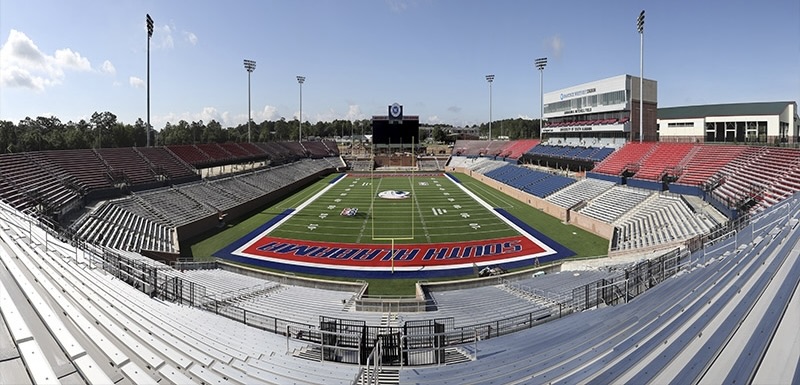
Hancock Whitney Stadium on the University of South Alabama campus seats 25,450 and already hosts two AHSAA all-star games. (Photo courtesy of Mobile Sports Authority)
 The Super 7 state football championships will be the most significant sporting event in Mobile’s history if it can join in a rotation with at least two other cities.
Mobile’s chances were enhanced Wednesday when the Alabama High School Athletic Association finally made the long-expected announcement that Bryant-Denny Stadium and Jordan-Hare Stadium were being removed as Super 7 sites so those arenas will be available for the expanded College Football Playoffs.
The odds are good for the Super 7 to come to Mobile every three years. The AHSAA’s Central Board has signaled it wants its marquee event moved around. The association would likely pay far less in rent than what it gave for the privilege of playing at the state’s most hallowed fields. Mobile has 6,000 hotel rooms which will be mostly vacant in December. Ultra-modern Hancock Whitney Stadium already hosts two AHSAA all-star games and the fervor over the state championship games being played here will make it relatively easy to raise at least $200,000 every time the Super 7 comes ashore.
Mobile never had a chance when all it could offer was Ladd-Peebles Stadium, although Legion Field was almost as decrepit from 1996 to 2008, when it welcomed the state’s best football teams in the final duels to win a Blue Map.
Mobile Sports Authority Executive Director Danny Corte said his organization began preparing the groundwork to get the Super 7 two years ago and added Mobile has shown the AHSAA it can more than do the job because its North-South Game and the rotating Alabama-Mississippi All-Star Classic have been successful here.
“I saw this possibility coming,” Corte said. “I felt those games were important for the leadership of the AHSAA and we saw the value in it. We knew it would help us later. That was my hook.”
Birmingham’s Protective Stadium will host the Super 7 in December and also in 2027 and 2030. The rotation that seems most logical is Protective Stadium, Hancock Whitney Stadium and either the Cramton Bowl or Alabama State’s much newer stadium in Montgomery, especially given the available rooms in those cities.
“Now here’s our opportunity,” Corte said. “We’re going to tee it up.”
Considering the fact that 43,014 fans attended the games in Tuscaloosa last year and 61,519 the year before in Auburn, the Super 7 will be the largest tee party in Mobile history if it happens.

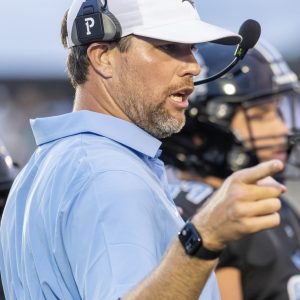
Mobile Sports Authority Executive Director Danny Corte.
Corte said the 1994 American Bowling Congress’ 91st Championships was the biggest event in Mobile’s history, with 46,425 people attending over five months, but that will pale in comparison to the Super 7.
“If we get the Super 7 and 46,000 people coming through the gates in three days, that becomes bigger than anything in Mobile — bigger than the Senior Bowl and the 68 Ventures Bowl,” he said.
Bigger than the Senior Bowl? That Mobile institution and the Super 7 serve different purposes but playing for a state championship gets into people’s hearts.
The Senior Bowl — while still significant and much loved locally — has changed. The game itself used to be a highlight and fans loved the South vs. North format. In these politically correct times, the game is secondary to the practices, which most fans don’t view as the event of a lifetime. It’s a week of clinics tuned more to the benefit of the NFL.
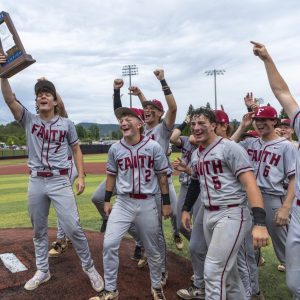
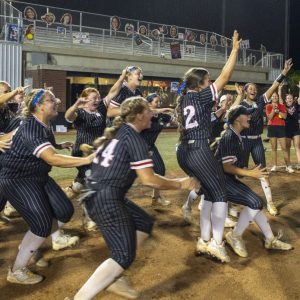
By contrast, high school football — despite its move toward becoming a big business — is still the most grassroots of events. Thousands from even the smallest towns in Alabama will flock here. It means something. It is something to be cherished for a lifetime, even if your team loses.
The new Super 7 rotation will be one of first major decisions to involve new AHSAA Executive Director Heath Harmon, although the association has time to consider all the factors.
“Once Heath gets in in July, I think the conversations will start,” Corte said.
Corte thinks Troy University and Jacksonville State University will also make bids but neither has the lodging capacity of Mobile, Birmingham and Montgomery, while Huntsville doesn’t have a large enough facility.
Protective Stadium has many advantages, although it is unlikely to hog the Super 7 by itself. It has the largest capacity (47,000), plus 34 suites and four locker rooms, which the AHSAA insists on. Hancock Whitney Stadium holds 25,450 fans with 11 suites and two locker rooms. Alabama State’s stadium, which opened in 2012, seats 26,500, has 20 suites and five locker rooms. The renovated Cramton Bowl seats 25,000 fans with two locker rooms and no suites.
“I like that rotation,” Corte said. “It gives us a chance to budget for it over several years.”
It’s expensive to host the Super 7 but well worth it.
The City of Birmingham, its convention and visitors bureau and the Birmingham Jefferson Civic Center Authority signed a deal in October 2020 to pay the AHSAA $200,000 for each Super 7, so that’s $600,000 for 2024, 2027 and 2030.
Corte said that figure will likely go up in the new negotiations.
“But just by the economic impact alone, it’s $15 million to $20 million over three days,” he said. “Nothing we do in Mobile will have more of an impact. They had 40,000 at Bryant-Denny last December and 60,000 at Auburn the year before. You have 40,000 coming to Mobile in December when the hotels need occupancy, I think we’ll be able to raise the money. I started the conversation a year ago with all of the entities.”
Corte said he has already started talking with USA athletic director Joel Erdmann about logistical issues — such as creating more locker rooms and suites at Hancock Whitney Stadium — but they will be solved given what is at stake.
“I feel good but there’s a lot of work to do,” Corte said. “We’ll have to create a volunteer base but that’s not a problem. There will be a lot of excited people.”
Why not Mobile? Many people upstate will say it’s too far to drive but that’s what teams in the southern part of the state have done for years.