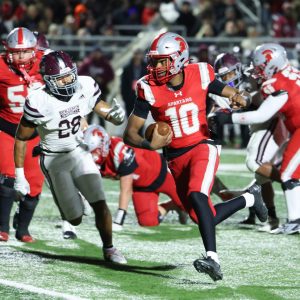
Chance decision turned out right for Saraland’s Jeff Kelly, who learned how to coach football on the job and became one of the state’s best

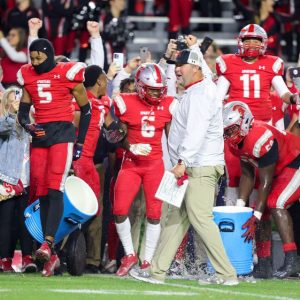
Saraland coach Jeff Kelly and his players celebrate in the closing moments of the 2022 Class 6A state championship game at Jordan-Hare Stadium. The Spartans beat Mountain Brook 38-17 for their first Blue Map. (Call News file photo)
By JIMMY WIGFIELD
SARALAND — If not for a chance visit by a UPS driver 20 years ago, Jeff Kelly might be running the worldwide shipping giant instead of coaching football.
Like UPS, Kelly knows how to deliver the goods. UPS says its on-time delivery rate is 97.5%. Kelly is practically as good as a coach, winning 95% of his games the last three years as his Saraland program has reached its zenith.
The No. 1-ranked Class 6A Spartans (11-0) are making their 14th straight trip to the playoffs this season and continue their quest for a third straight appearance in the Super 7 on Friday against No. 4 Spain Park (12-0) in Saraland.
Kelly hadn’t considered coaching after a career as Southern Miss’ starting quarterback and two years in the NFL with the Seattle Seahawks. He had a master’s degree in business administration — in fact, he was voted the top banking student in Mississippi — and was ready to enter the financial world.
“I never really wanted to coach and wasn’t really thinking that was what I was gonna do,” he said. “I had some opportunities in the business side of things and investment side of things.”
But Kelly has 190 victories in 21 seasons, including the best record in Class 6A the last five years (60-8). His teams have averaged 45 points per game the last three years, won the 2022 state championship, developed one of the richest veins of talent ever concentrated in one school and made five trips to the state finals — much to the chagrin of his contemporaries, who would have preferred seeing Kelly behind a desk working on spread sheets instead of a spread offense.
That would have given him some pleasant alternatives had he never blown a whistle.
“I’d probably be at the beach right now,” Kelly said. “I’d probably be on a boat fishing. But I don’t know that my life would have been near as fulfilling.”
Learning how to coach
Not long after Kelly’s NFL career was over, a UPS driver came to his parents’ exterminating business bearing packages and news that changed Kelly’s life.
“My wife’s the principal at Satsuma High School,” the driver said, as recalled by Kelly’s mother, Neci. “He needs to go up there and apply for the coaching job.”
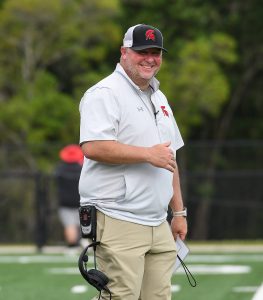
Kelly had a terrible start to his coaching career at Satsuma, saying in the beginning he was more of a friend to the players than a demanding coach. (Call News file photo)
That was in 2004 and the Gators had lost 21 straight games. Not only that but Kelly, who was 23, had never been an assistant coach.
“I said I’m going to give it a try and see what it’s like,” Kelly said.
It was miserable. Most of the games the first two seasons were lopsided losses.
“I knew a lot of football,” Kelly said. “I didn’t know how to coach. I didn’t know how to do all the other stuff that wasn’t X’s and O’s related. There was a lot of times I was trying to figure out if this was something I wanted to keep doing.”
The third year started just as badly as the first two but, at 0-3 after a 45-12 loss to Daphne, Kelly had grown weary of permitting a lax attitude throughout his program and became a more demanding coach, feeling he had nothing to lose.
“I was ready to get out at that time and got to the point where I made a decision where I was going to run the program a certain way,” he said. “I didn’t care if anybody liked it. I didn’t care if it worked or not because if it didn’t work, I was getting out anyway and going to do something else.”
Kelly said he learned how to manage people and made clear his daily expectations. As a result, Satsuma won seven straight games for only the second time in school history — it hasn’t been done since — and made the playoffs.
“I can remember it as clear as day and all of a sudden, we started winning,” Kelly said. “There were probably times, me being really five years older than the players, I probably was as much a friend versus a coach in the first year or two. I probably cared too much about what everybody thought. I tried to make too many people happy but I just got to the point of not caring what folks thought.”
Kelly was setting a standard he has not deviated from since.
“It was a focus on doing the little things right in terms of being on time, ready to go every day, having the right mindset, how do you go about practice day in and day out, the importance and urgency that you’ve got to place within every practice,” he said. “I learned what not to do in those first two years.”
Kelly was 15-26 in four years at Satsuma with two playoff berths — something no coach there before or since has done. Then, he went 32-8 in three years at Jackson, which up to that point was the best three-year span in school history, including finishing as the Class 4A runner-up in 2009.
‘Have we done the right thing?’
After Saraland finished 3-7 in its first and only season under John Holman, the fledgling school system turned to Kelly to build its program. Fourteen years later, that remains the Spartans’ only losing season and Kelly remains the only original member of the staff still on the job.
But Kelly’s first practice at the school in the spring of 2011 made many of the assistant coaches wonder if they had made the right decision to come to the school or if they’d even have enough footballs to last the season.
“Back then, the practice field was surrounded by a swamp,” said former assistant coach Scott Croley, a longtime friend of Kelly’s who is now the school’s principal. “I think we lost somewhere around a half a dozen footballs during that first practice.”
Since they had no meeting space, the coaches sat on the tailgates of their pickup trucks afterward feeling anything but confident.
“I don’t recall that anyone said it but I can promise you every one of us were thinking, ‘Guys, have we done the right thing here?’” Croley remembered. “We were just all kind of looking at each other and not really knowing what the future was going to hold. And then coach Kelly makes it to our little pseudo-staff meeting and it’s already, ‘This is what we’ve got to do tomorrow, this is what we’ve got to do the next day.’”
It made an impression on Croley.
“It just speaks volumes of the vision that Jeff had and continues to have,” he said. “Still being around him every single day, it’s never one of those things where we’re sitting on our hands. It’s always, ‘What can we do better?’ I think he knew that from day one and that just bled over into us and then, obviously, that bled over into the kids.”
Surviving and thriving
Kelly, who was born the week before Hurricane Frederic struck Mobile in 1979, became a successful quarterback but not before surviving the storm and nearly having his ear ripped off on a trampoline when he was 4.
The future quarterback experienced the value of good protection during Frederic.
“We turned the pool table over up against the window and me and Jeff and his grandmother slept there,” Neci Kelly said.
His father Tommy, never one to gab, described the danger succinctly.
“I knew we was having a problem when you could hear bricks falling on the roof,” he said.
Another near disaster came the day before Kelly’s first youth game with the Saraland Rebels, when his ear got hung on a trampoline spring next door.
“Somehow, all of them got his ear out of the spring,” his mother said. “We rushed him to the doctor. It wasn’t too bad, five or six stitches. But the next day, he played his first football game with that helmet on and never complained.”
Kelly pitched from a mound his father set up in the yard and began showing signs he had an exceptional arm when he was about 10. But after the family moved to Deer Park, Kelly didn’t make Citronelle coach Ronny Massey take notice the day he and his father visited to inquire about joining the football team.
“Ronny just kind of blew it off but, of course, it turned out that he was not just another guy,” said Rotch Dungan, who was the offensive line coach and went on to coach for Kelly at Satsuma, Jackson and now Saraland. “I remember telling Ronny, ‘You know, that may end up being a pretty good guy there.’ I knew Jeff’s dad and his mom from before and I knew they were both really good athletes.”
Dungan said Kelly’s arm strength was obvious but he had even more dazzling qualities.
“It was his poise, his confidence,” Dungan said. “That was always the part that caught my eye, the way he handled other people around him. He was that cool, relaxed guy that didn’t get frazzled.”
Dungan also didn’t see Kelly becoming a coach — “When he called me and told me what he was planning on doing, I was floored” — but once he took the Satsuma job, Dungan said he had to get Kelly to change his thinking about offense.
“He had a pro background and high school was just a little bit different,” Dungan said. “When Jeff started this thing out, it was like you could never run the same play twice from the same formation during a single game. Something had to be different but those defenses were smarter than that. Well, we get in high school and we have a great play and I’m wanting to run it again, so that was a disconnect there. We had to get to where we understood each other, that if it’s a good play once, it’ll be a good play again. But he wanted to add some motion to it or something different if you’re going to come back to it. I think he’s figured out that if it works, it works.”
Kelly acknowledged finding his way through trial and error.
“With time comes wisdom,” he said. “You know what works and a lot of times, more importantly, you know what doesn’t work.”
Far more than talent
It took Kelly six years as a coach before he reached his first state championship game and 19 before he won his first Blue Map. In between, he steadily built an elite program which has won 10 or more games in nine of the last 12 seasons, including the last seven straight, the only Class 6A team to do it. The only other team in the state to do it during that same span is Class 3A Mars Hill.
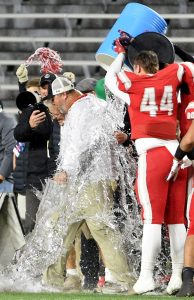
It took 19 years before Kelly got to enjoy a celebratory ice-water bath for winning the state championship. He has won with great players and average players. (Call News file photo)
While Kelly has in the last decade coached some of the finest talent in the nation, he has also won with average players.
“Jeff’s always been able to wave that magic wand and give our players something to believe in when we’re outmanned,” Croley said.
Dungan said Kelly makes sure all of his players feel they have an important role.
“Every team is going to have a handful of guys that stand out,” Dungan said. “But those glue guys, those other guys that kind of hold the program together, those are the guys that the program’s built around. He does a good job of making them all feel like everybody has a role.”
That attitude extends to his coaches.
“I don’t think there’s ever been a single day I feel like I worked for him,” Dungan said. “It was always we’re working together.”
The roster of great players Kelly has coached gets longer each year, including receiver Velus Jones and defensive back Cordale Flott, both of whom are in the NFL. The list also includes quarterback Jack West, defensive lineman Trevon McAlpine, receiver Jarel Williams, current quarterback K.J. Lacey, receiver C.D. Gill, running back Santae McWilliams, defensive lineman Antonio Coleman and receiver Dillon Alfred, all of whom played with the state’s only two-time Mr. Football, Ryan Williams, a player of national renown who has goals of winning the Heisman Trophy and becoming a No. 1 overall NFL draft choice.
Opposing coaches say Kelly’s success bores deeper than the talented players he commands.
“He slowly built the culture the way he wanted it,” said former Theodore coach Eric Collier, who was 2-2 against Kelly. “And you see that now. That’s why he’s maintained his success. That’s why he’s winning year in and year out. He’s going to lose some great players but they’re not going to go away. He’s built that thing right. He’s not going to fall off because those kids believe in what he’s doing.”
Collier said Kelly’s tenets of success are rooted in the basics of football.
“Jeff’s really sharp,” Collier said. “What I always appreciated out of him is his team was always going to be well-prepared scheme-wise and they were always going to play physical. So, if you don’t go in there and try to match that, you’re going to have a problem. You’re not going to out-scheme him. I always tried to slow the game down and execute on both sides of the ball.”
Dungan said Kelly constantly adapts to his players and is an avatar at breaking down defenses no matter what system he runs.
“Every year, you think, ‘Well, Saraland has just got it going on, let’s go walk in every year and do the same thing,’” Dungan said. “That’s not true. You have different strengths and next year will be another example of that. He’s not just locked into something — hey, we’re going to throw the ball down the field regardless of who we’ve got back there. He plays to the strength of the guys that we’ve got. The second thing that makes Jeff stand out a little bit is his understanding of defenses. There’s always an answer. And part of that is him doing his homework on it. In every situation, it’s always an answer. He knows if they do this, here’s what we do. There’s never no poke-and-hope-type mentality to it. It’s well thought out. And that’s from Sunday pregame scout-type stuff all the way through the week.”
Lacey, who transferred from Daphne to Saraland after his freshman year, said Kelly’s preparation is a torch in the night.
“It’s his way of adjusting,” said Lacey, who under Kelly became one of only five quarterbacks in state history to pass for 10,000 career yards. “He’s always prepared. He’s played against a lot of these teams already or knows what the coach’s tendencies are. So, coming into the game, we always have a plan of what we need to do to win the game and we’re going to have to adjust to it. Coach Kelly has his whole play sheet and then he has his little backup plays for if they come out in some different stuff. It’s his situational awareness and knowing when to run what he needs to run and put me in situations to make plays and let everybody shine.”
Coaching on a tightwire
Kelly is particular about who he surrounds himself with, preferring assistants with deep ties to him and his program. Dungan is an example, as are the half-dozen former players who are on his staff.
“As you get older, you look at that part of your career and how you’ve affected other guys,” Kelly said. “There’s no doubt that I wouldn’t have got into coaching had I not played for coach Massey in high school. Whatever I’ve been able to do, good or bad, really goes back to his influence.”
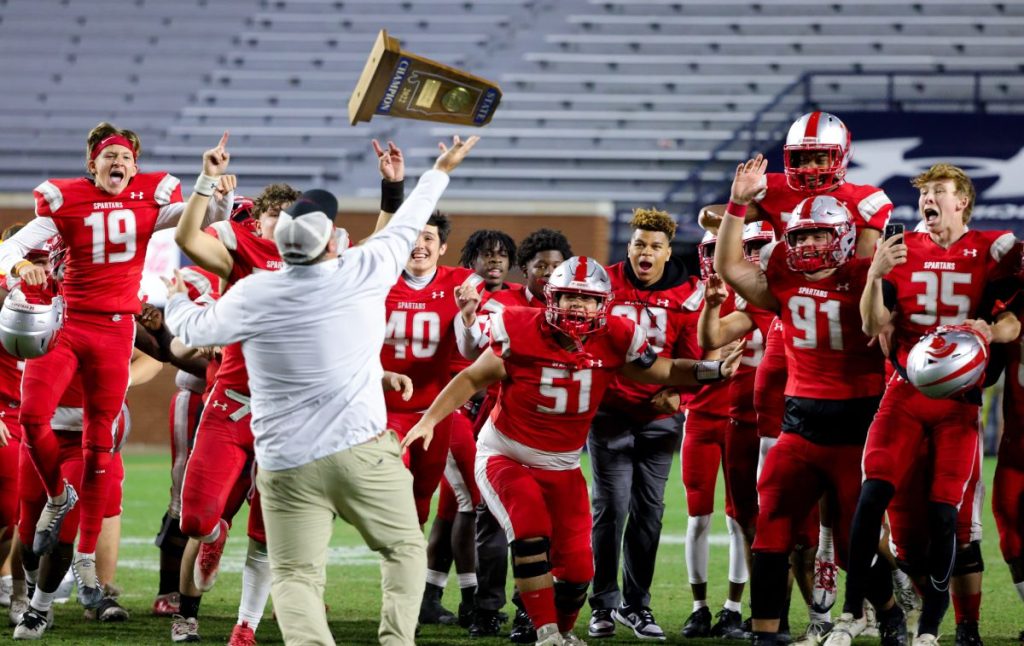
Kelly, who always gets antsy on game days, showed he still has good hands when in jubilation he juggled the Blue Map and then brought it under control before it hit the ground. He had both feet inbounds. (Call News file photo)