Compromise needed before disaster strikes Alabama high school sports
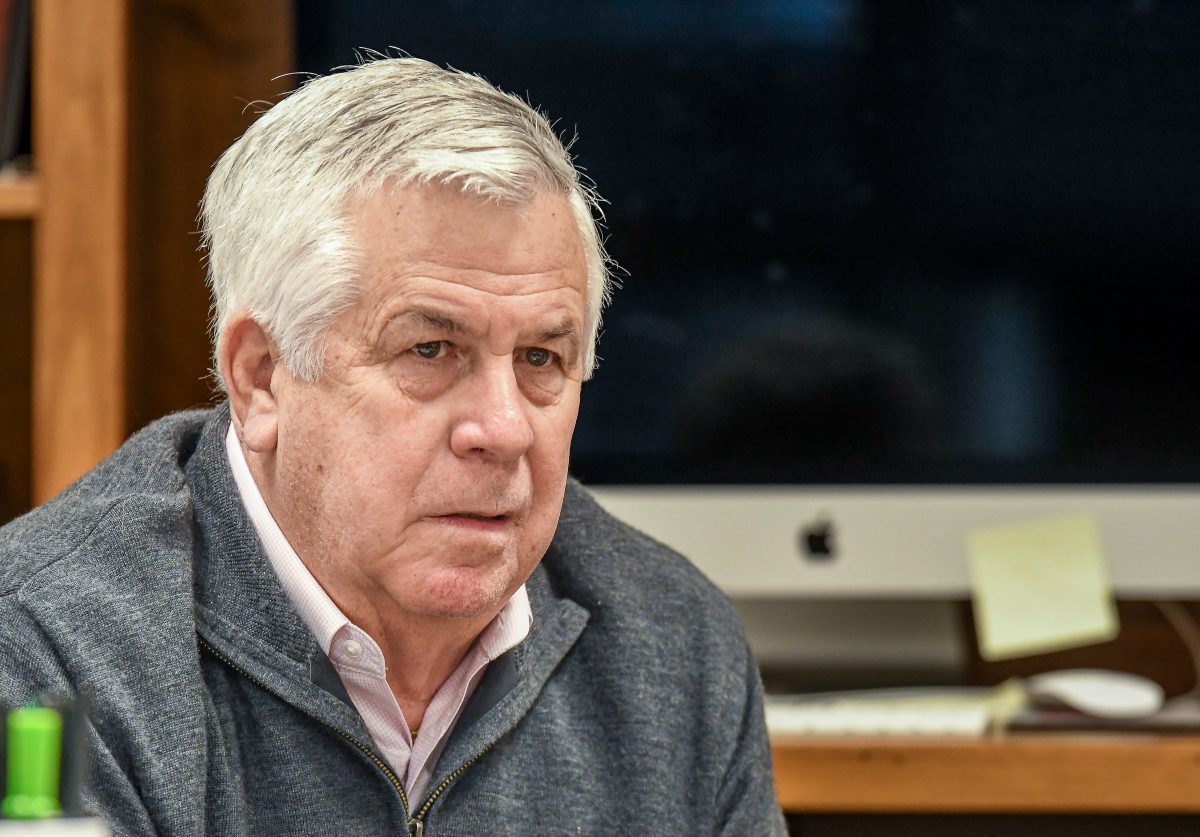
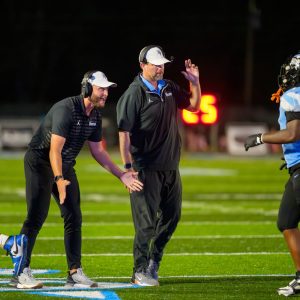
Legendary former UMS-Wright coach Terry Curtis sees both sides of the issue that could lead to private schools being separated from the Alabama High School Athletic Association, a decision he said keeps him up at night as president of the Central Board. (John O’Dell/Call News)
______________________________
A simmering feud between public and private school athletics in Alabama has come to a boil and a landmark decision could soon settle it. At the heart of the issue is recruiting — each says the other does it.
A split is the worst possible answer but can it be avoided?
______________________________
 Terry Curtis knows a decision he will soon help make might be the most monumental in the history of high school athletics in Alabama.
It could be the moonshot at its loftiest. It could also be the Hindenburg at its lowest.
Will public and private schools be parted in a fashion that will alter the Alabama High School Athletic Association forever? Will private schools — fed up with perceived injustices — form their own association to the detriment of the whole? Will all the schools finally clasp hands and take whatever time is needed to repair the rift?
“Believe me, every time I wake up at night, it pops in my mind,” said Curtis, the legendary former head football coach at UMS-Wright and current president of the AHSAA Central Board, which will make the historic decision, possibly in January.
“It’s hard to think about anything else,” Curtis said. “If something drastic or whatever is done, it’s going to change everything we’ve done. It’s going to really change the association even. Not only just the schools but the association.”
‘Rules need to change’
The storm clouds of a split have been gathering for years and grew darker in recent months because of internal strife and unwelcomed outside intrusion. It’s so serious that the AHSAA’s biennial reclassification announcement was postponed from December to Jan. 23.
Public schools — which form the overwhelming majority of AHSAA members — have long punished private schools for an adjudged advantage in recruiting players by using the multiplier and the competitive balance rules as drags.
The AHSAA multiplies private school enrollment by 1.35 and assesses the equivalent of penalty points to private schools which perform well with the effect of boxing them into higher classifications to weaken their competitiveness.
“I had 26 kids this past season, 29 the season before, playing 4A football, which was not fair,” Mobile Christian coach Charles Lawson said. “Honestly, for me to get them ready, I had to beat them in the ground just so they could be able to compete.”
Those rules were justified as necessary because private schools are not limited by attendance zones. But that has changed in the era of easy transfers, as no less a respected authority than Steve Mask, who successfully coached in public and private schools, forcefully argued upon his recent retirement.
“We should stay where we are supposed to go to school,” he said. “I’m sick of the recruiting part of it. One thing I want to say publicly — don’t talk about private schools recruiting. It ain’t even close to what’s happening in public schools. A lot of people are afraid to say that. I’m not afraid to say that. Go see what’s happening in Birmingham. See what’s happening in Mobile. See what’s happening in Montgomery.”
Lawson said he sees it all the time.
Mobile Christian coach Charles Lawson said private schools are treated unfairly and that public schools have recruited his players. (Helen Joyce/Call News)
“We get punished because they say private schools are recruiting,” he said. “But I’ve lost so many kids to these public schools around here that’s recruiting. I have kids that are loyal to me that show me messages that come from these other coaches and these other schools but nothing is being done. I feel like their way of getting away with that is doing that split and letting these public schools still do what they do.”
Ham Barnett, who followed Mask at St. Paul’s, said public schools have more resources.
“The public schools, if anything, probably have a bigger advantage than private schools when it comes to recruiting now,” he said. “You’ve got to look at these city schools (systems). They have state money and federal money and we’re a private entity. Those times have changed and the rules need to change with them.”
Hypocrisy at its worst
The CHOOSE Act — a good law that provides school choice — has brought with it unintended consequences and heated the public vs. private controversy to a boil due to unneeded interloping from state government.
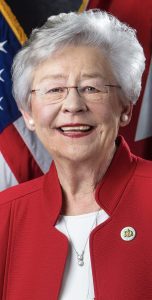
Gov. Kay Ivey often rails against big government overreach but wants to do precisely that with her lawsuit against the AHSAA. (Alabama.gov photo)
Gov. Kay Ivey and Alabama House Speaker Nathaniel Ledbetter have sued the AHSAA because the association makes players who transfer to private schools using CHOOSE Act funds ineligible for a year. Ivey, who doesn’t think players should sit out, surely has more pressing governmental matters to tend to between naps and bashing liberals, a time-honored pastime in Alabama.
Conservatives such as Ivey and Ledbetter often rail against big government overreach — and rightfully so — but now want to hypocritically do the same thing they disparage others for. The AHSAA is a private organization which does not operate on taxpayer funds and should be left to resolve its internal squabbles without misguidance from politicians.
But AHSAA officials must be cautious of the repercussions of criticizing or opposing Ivey. In 2022, Mobile County Circuit Judge James Patterson, a fellow Republican, was temporarily suspended for violating ethical standards and, among other things, mocking the elderly Ivey as “Governor MeMaw” — a popular rejoinder that has aged well, even if Ivey’s argument against the AHSAA has not.
Limited to two terms in Alabama, does Ivey think she could run for governor in Mississippi right away if she moved (or, dare it be said, transferred)? Over there, Kay, you have to sit five years before running.
Who has the advantage?
It’s ludicrous to argue that private schools somehow have a competitive advantage over public schools when counting state football championships. In the 10 years before the multiplier was instituted in 2000, private schools won only two (both by Briarwood); in the 10 years afterward, it grew to eight and now 26 private schools have won Blue Maps. Somehow, competitive balance has resulted in 20 state championships by private schools in 18 years; in the 18 years before that, it was only eight.
So, why do private schools think this is unfair? Because they have been artificially moved into higher classifications to ostensibly prevent them from hogging all the Blue Maps by the same group of public schools that have won 79% of the state football championships since 2000. Perhaps private schools would have won even more without the restrictions but it can’t be proved.
Unless a compromise is reached — and that’s imperative — private schools could be forced to stage their own playoffs separate from the public schools at the least and at worst be completely amputated from the public schools year-round. The quality of competition would also be watered down.
“I want to stay where we’re playing public and private together,” Barnett said. “I just think there’s something special with it because I think we’re the only state in the Southeast that still does that.”
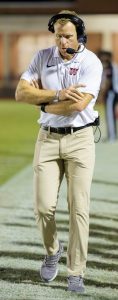
UMS-Wright’s Sam Williams, who was an ultra-successful coach in Mississippi, said splitting public and private schools will have terrible consequences. (Helen Joyce/Call News)
UMS-Wright coach Sam Williams, who took Brandon High (Miss.) to three Class 7A state championship games in four years, said separation will pollute the contentious atmosphere even more.
“In Mississippi, it’s two completely separate associations that don’t really associate with each other, almost to the point of being frowned upon sometimes to play across associations,” he said. “If people think recruiting is bad now, just imagine what will happen. In Mississippi, it’s just two completely separate associations that have two completely different set of rules.”
Curtis is also wary of the afterburn of separation based on events in neighboring states.
“The ones that have separated, it hasn’t worked out for really any of them,” he said. “All these other states have so many more private schools than we do, so separating was not that big a deal for some of them.”
Timely compromise needed
Curtis wants the AHSAA to rectify the problems on its own, although the AHSAA’s process has been a creaking mechanism that may be forced to speed up out of necessity.
Curtis acknowledged the probable turmoil of rushing a decision by Jan. 23 or even by the end of 2026.
“I’m not sure that it is right for our kids at this point in time to all of a sudden say we’re going to separate and try to do it all in the next six months,” he said. “If that’s the way it needs to go, at least let’s put it off for two years to the next classification period and have some conversations and see what we’re going to do. At least you’ve got two years to prepare for it.”
Meanwhile, a temporary restraining order lets students who use CHOOSE Act funds play sports without sitting out a year while the state and AHSAA are in court-mandated mediation. If the AHSAA can run out the clock on Ivey, it will likely find an ally in her successor, former Auburn coach Tommy Tuberville, who might order the lawsuit withdrawn.
Many private school coaches want to see the multiplier eliminated and competitive balance applied to all AHSAA schools.
“What I would like to see is a fair playground for these kids. Private, public — everybody should be treated the same,” Lawson said. “I just feel like it should be based on the true (enrollment) numbers of the school and that’s where you play at.”

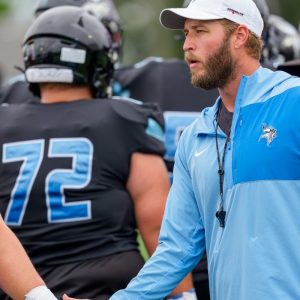
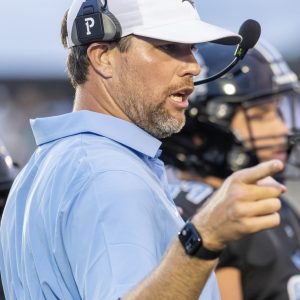
St. Paul’s coach Ham Barnett said eliminating the multiplier and applying the competitive balance rule fairly is the right thing to do. Otherwise, “There’ll probably be a lot of private schools that would want to say, ‘We’ll just form our own association and govern ourselves.'” (John O’Dell/Call News)