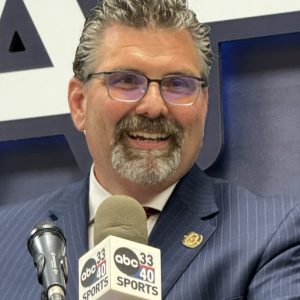
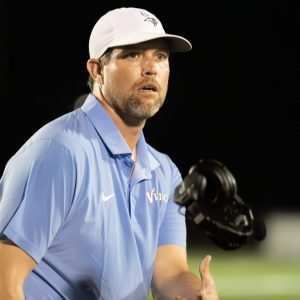
Golson says he ‘skimmed’ rulebook but denies recruiting; Harmon challenged on proper rules changes
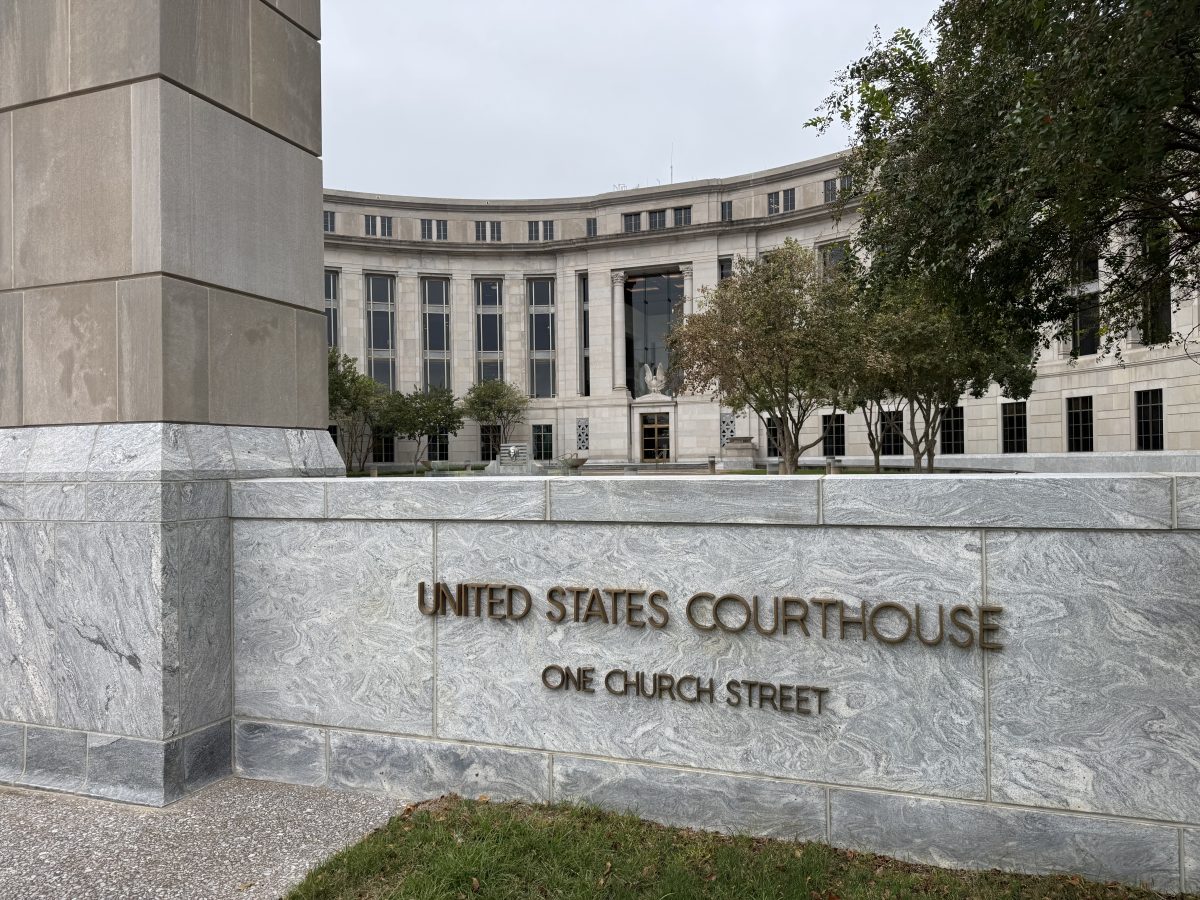
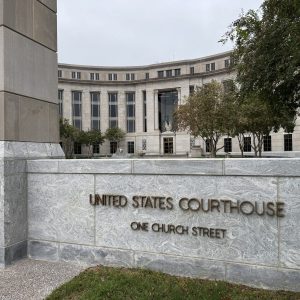
The Frank Johnson Federal Courthouse in downtown Montgomery, where a hearing in a federal lawsuit filed by two mothers of Mary G. Montgomery students was held Monday. (Jimmy Wigfield/Call News)
By JIMMY WIGFIELD
MONTGOMERY — In two lengthy spasms of testimony Monday within earshot of each other, former Mary G. Montgomery coach Zach Golson admitted he “skimmed” through the Alabama High School Athletic Association’s handbook but AHSAA Executive Director Heath Harmon offered no documentation that the rules he used to punish Golson and the school were properly enacted.
However, in the first legal airing of a case in which the AHSAA penalized MGM for what it called violations of its recruiting rules, including charges of improper contact, U.S. District Judge Bill Lewis seemed intrigued by what Golson said was a denial of his rights to defend himself in the investigation. Lewis questioned why MGM didn’t appeal Golson’s one-year suspension, whether the rules the association cited were properly approved or not. After self-reporting the violations connected to a freshman signing ceremony, Principal David Diaz put Golson on administrative leave two weeks before Harmon issued the sanctions.
“It sounds like the school sold you up the creek,” Lewis said.
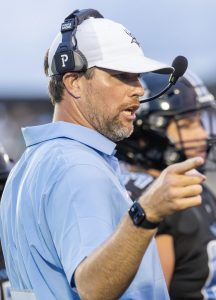
Golson
Golson — who has filed a separate lawsuit charging he was defamed and denied due process — responded by saying no local or state officials would let him tell his side of the story.
“I tried to reach out (to MGM officials),” Golson replied, “and they would not appeal on my behalf. The AHSAA told me I had no voice, no due process, that I could only appeal through a member school. I met with the investigator without (legal) representation. This is the only time I had a chance for a face-to-face.”
For the first time since Harmon imposed a one-year restrictive probation and playoff ban against MGM and suspended Golson for a year, the two men were brought together under the same roof at the Frank Johnson Federal Courthouse for a 4½-hour hearing on Monday before Lewis in a lawsuit filed by the mothers of two Mary G. Montgomery students.
Harmon listened intently as Golson mounted the stand first, then Golson sat in the back of the courtroom with his wife Sarah to listen to Harmon.
Students not
formally enrolled
Tameka Dale and Ashley Davis — the mothers of two MGM students who were among the 21 students declared permanently ineligible to play sports at the school for attending what the AHSAA characterized as an improper recruiting event — filed a federal lawsuit seeking a temporary restraining order and a permanent injunction to restore their sons’ eligibility plus compensatory damages for irreparably harming their sons’ futures. Nineteen of the 21 students have since left MGM.
Dale and Davis claimed their constitutional rights of free speech and equal protection and those of their sons were violated by the AHSAA, which found in May the students were connected to violations of recruiting rules for attending MGM freshman football signing ceremonies in 2024 and 2025. Their lawsuit named Harmon, Mobile County Public School System Superintendent Chresal Threadgill and Diaz as defendants.
Lewis gave no timeline on when he will issue a ruling on a temporary restraining order and a permanent injunction.
The AHSAA’s attorneys established that Dale’s and Davis’ sons — honor students identified as T.D. and B.G. — were not formally enrolled at MGM before attending the signing ceremonies in 2024 and 2025, although they had completed paperwork to transfer from Clark-Shaw Magnet School. Dale, Davis and Golson said no inducements were offered to their sons, nor were they invited to any of the ceremonies.
While Dale and Davis filed the lawsuit, their testimony was cleared out of the way early in the proceedings so the lawyers could question Golson and Harmon at length.
Golson was warned by Lewis that anything he said in Monday’s hearing could be held against him in his state lawsuit against the AHSAA, Harmon, Threadgill, Diaz and investigator Chuck Anderson.
Golson pressed ahead and faced aggressive cross-examination by AHSAA attorney Joe Espy. At one point, plantiff attorney Michael Kidd poured Golson some water in a Styrofoam cup and brought it to him on the witness stand.
At another juncture when Golson tried to read back a portion of the AHSAA handbook at Espy’s request, Espy asked Golson, “Do you have a college education?”
“I have a master’s,” Golson replied.
Lewis admonished Espy for the remark.
Clashing over rules
Espy said Golson staged phantom practices for eighth graders, intentionally broke recruiting rules and hid behind a lack of knowledge of those rules. Espy pointed to testimony by Davis and Dale that they attended the freshman signing ceremonies with their sons, who signed a creed agreeing to uphold certain standards Golson had set, momentarily put on MGM jerseys and had their pictures taken. Espy also said a letter Harmon sent to the school said the sanctions were the result of Golson’s visits to Semmes Middle School and the signing ceremonies, plus the honesty of the students interviewed.
Golson said the ceremonies, which began in 2022, had always been approved by Mary G. Montgomery administrators and he made it clear to Diaz that he had not recruited players.
“But the principal didn’t believe you,” Espy retorted.
Kidd said an original recruiting bylaw in the 2015-16 AHSAA handbook was improperly changed in succeeding years to say no student or parent could come to a school on their own to inquire about athletics. The original rule said such visits were permissible “for any specific purpose.” Kidd also said other iterations were later incorrectly altered.
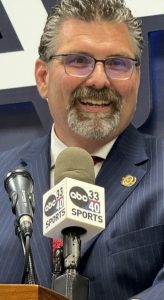
Harmon
Harmon said Golson should not have given any students not zoned for or enrolled at MGM a jersey to be photographed in.
“It sounds like somebody is encouraging them to sign to play football,” Harmon said.
Kidd maintained that Harmon had no evidence the players signed a contract to play football at MGM and pointed to a written rule that any bylaw could be changed only by the AHSAA’s Legislative Council and not the Central Board or the executive director.
“I have asked them repeatedly to give me documentation (that rules were changed properly) and they can’t because it didn’t happen,” Kidd said.
However, AHSAA lawyer Ben Espy said documents showing the Legislative Council did not approve the recruiting bylaw changes could not be verified as legitimate. When Lewis asked if the changes could be authenticated, Harmon said a press release found by Kidd was not sufficient to prove improper alterations.
Harmon, Golson challenged